
May 17, 2026
OB-Xd 3.21 released
We're pleased to announce OB-Xd 3.21, a major MPE expansion bringing multi-destination Y-axis routing, automatic controller configuration, a hardware-named preset library, live LED modulation previews, and full-range timbral sweeps.
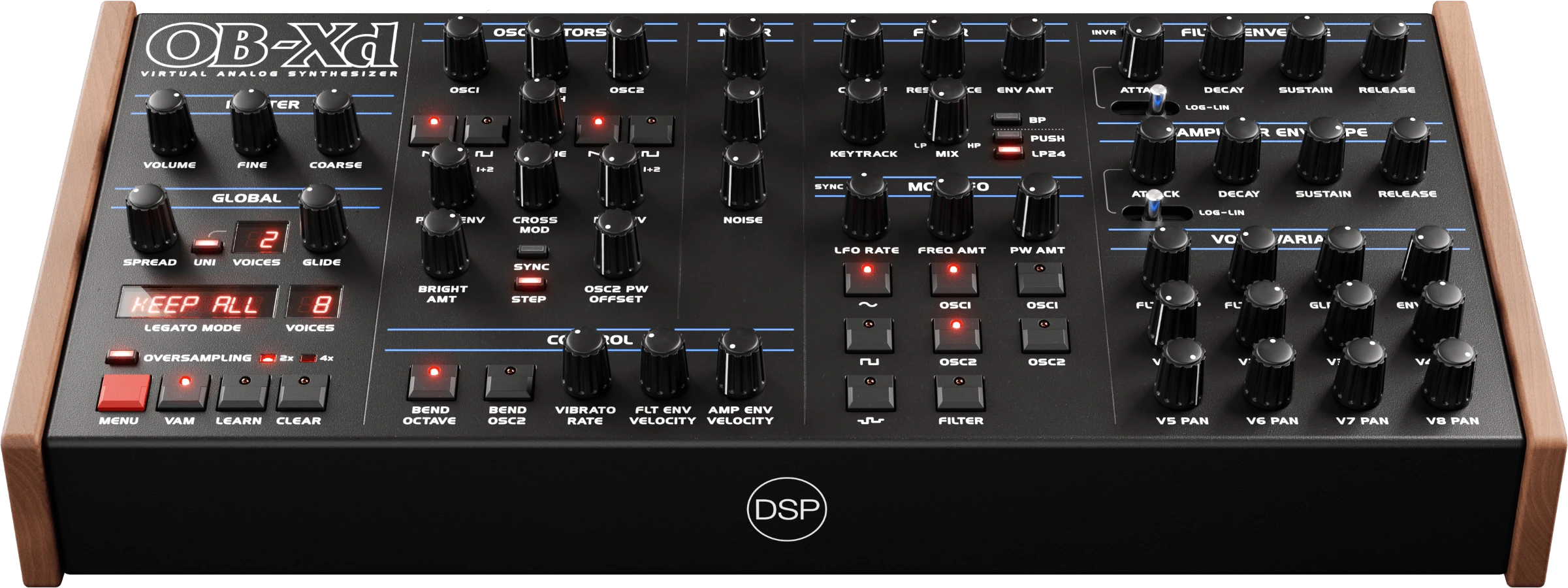
OB-Xd is a classic virtual analog synthesizer that recreates the Oberheim OB-X with enhancements like micro random detuning, polyphonic unison, and bi-directional MIDI control.
Version 3.21 turns OB-Xd into a fully expressive MPE instrument. Plug in a LinnStrument, ROLI Seaboard, Sensel Morph or Haken Continuum and the plugin auto-configures from the controller - no menu work required. The default aftertouch behavior now aligns with Roger Linn's How to add MPE developer notes.
What's New
- Multi-Destination Y-Axis (CC74): The Y axis can drive any combination of Pulse Width, PW Offset (Osc2), Cross Modulation, Osc2 Detune, Cutoff, Pitch, and Pan simultaneously. At 100% Y Depth a full Y excursion sweeps each destination across its full musical range. Factory default is Pulse Width + Cross Modulation - the timbral combination recommended for MPE because it changes how the wave sounds without affecting pitch or apparent volume. Old presets and global MIDI.xml entries auto-migrate to the equivalent single-destination bit.
- Automatic Controller Configuration (RPN): Plugin auto-enables (or disables) MPE when the controller sends RPN 6, with NULL RPN guard. RPN 0 updates the per-note bend range to match the controller (commonly 48 semitones). Both Lower Zone (Ch 1 master) and Upper Zone (Ch 16 master, used by LinnStrument) are auto-detected. Switching a LinnStrument, ROLI Seaboard, Sensel Morph, etc. to MPE mode is enough - OB-Xd matches the controller without any menu work.
- MPE Preset Library: Ships with hardware-named factory presets for LinnStrument, ROLI Seaboard RISE 2, ROLI Lightpad Block, Sensel Morph, Madrona Soundplane, KMI K-Board Pro 4, Embodme Erae II, Joue Pro, Artiphon Instrument 1, Haken Continuum, Expressive E Osmose, and discoDSP KeyPad - each with the correct bend range and Y-Rest convention. Native Save / Rename / Delete dialogs with a self-documenting filename suffix (e.g.
My Patch (Range 48 - X to Pitch - Y to PW+XMod - Z to Amp - Y-Rest Bottom).xml). Tweaks auto-save as a Custom snapshot so the latest setup survives reopening the plugin. - Live LED Modulation Previews: Every Y/Z destination knob shows a green LED dot that tracks the live MPE modulation in real time. The Volume knob's green MPE dot takes precedence over the blue VU peak meter when Z is routed to Amp; the Cutoff knob turns green when MPE is modulating the filter; pan slots pick up MPE pan offset; OscPitch and Detune show MPE presence as a green dot.
- MPE Z-Axis (Aftertouch) Default: Channel pressure now defaults to Amp (silence to full level, like wind pressure on a wind instrument), matching Roger Linn's MPE design recommendation. Cutoff, Pitch, and Off remain selectable.
- MPE Setup Menu & Workflow: All MPE configuration lives under MIDI > MPE Setup, grouped by axis with depth and range options for each. MPE Mode and MPE Preset sit just above as a contiguous group. Conditional visibility hides options that aren't relevant to the current routing. Auto-Enable turns MPE on automatically when you change any setting. New 3-semitone bend range matches the LinnStrument 128 hardware pad (range now offers 2 / 3 / 12 / 24 / 48 semitones). Per-axis depth 5% / 25% / 50% / 75% / 100%.
- LCD Status Feedback: The bank-name area briefly shows MPE ENABLED / MPE DISABLED for two seconds when MPE mode toggles. Bend range notifications show MPE Bend Range 48 (or similar) when the range changes; enable/disable messages take priority so you actually see the "ENABLED" notification when both arrive together.
This update is free for all OB-Xd 3.x customers. OB-Xd is available for Windows, macOS, and Linux in VST, VST3, AU, AAX, LV2, and Standalone formats, and Standalone and AUv3 for iOS.
May 15, 2026
Vertigo 5.3 and Retromulator 1.4 released
We're pleased to announce updates to Vertigo and Retromulator, featuring an FX preset system, envelope preset menus, quick-value LCD popups, and a new SID 6581 / 8580 hardware core.
Vertigo 5.3.0
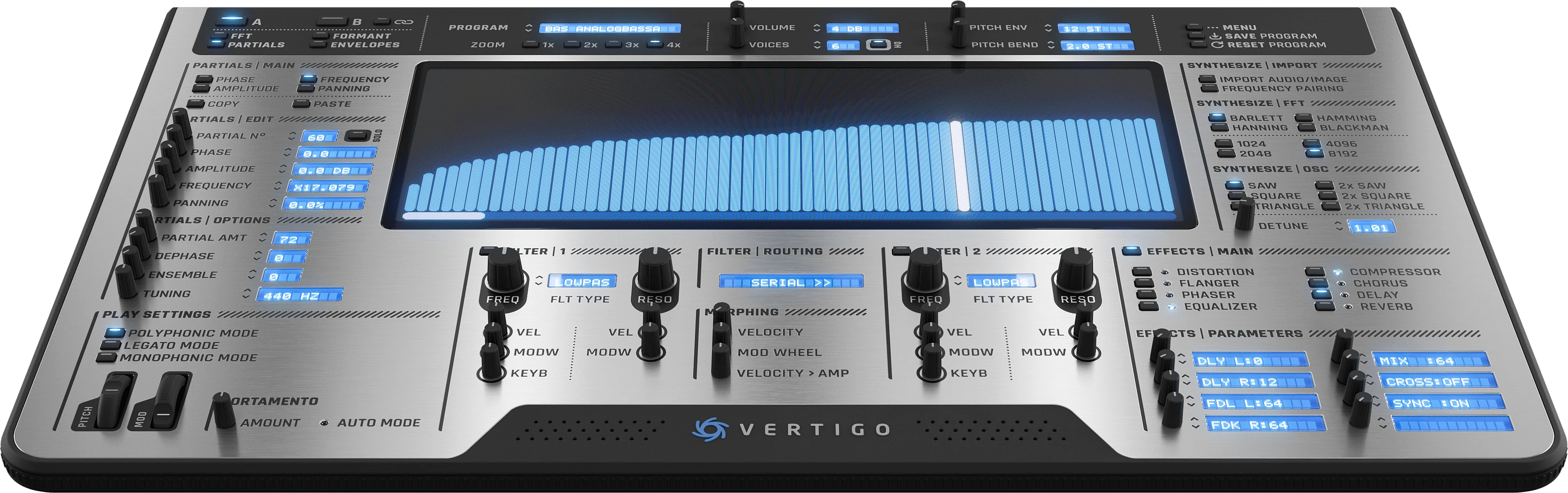
Vertigo is a powerful additive synthesizer with 512 partials, WAV/PNG image resynthesis, morphing capabilities, and real-time formant filtering.
Version 5.3.0 adds full FX preset and chain recall, an envelope preset menu tailored to each envelope type, and quick-value popups on LCD boxes for faster patch building.
What's New
- FX Presets: New FX preset system with XML storage and chain presets. Right-click or Shift+click any FX active LED button (or its label) to store the current FX as a preset or recall a saved one. Right-click or Shift+click the global FX active LED button to store or recall the full 8-FX chain.
- Envelope Preset Menu: Right-click or Shift+click the Reset label or anywhere on the envelope canvas to pick from a list of presets tailored to the selected envelope (Filter A/B, Pitch, Amp, Morph, Stretch). Alt+drag on the canvas proportionally scales the envelope on the time or value axis. Smoother envelope and spectral playhead with snapshotted positions and dirty-region repaints.
- Quick-Value LCD Popups: Click on the Volume, Voices, Pitch Env Range, Pitch Bend Range, Tuning or Partial Amount LCD box to pick from a list of common values. Click and drag on the same LCD still adjusts the value continuously.
- Numeric Input Dialog: Double-click numeric input dialog on operator and spectral value boxes (Phase, Amplitude, Frequency, Pan, Time Frame) and on envelope point boxes (Delta, Value, Slope).
This update is free for all Vertigo 5.x customers.
Retromulator 1.4

Retromulator is a multi-engine vintage synthesizer hosting cycle-accurate emulations of classic hardware including the Yamaha DX7, Roland JP-8000, Korg M1, Wurlitzer EP, and now the Commodore 64 SID.
Version 1.4 adds a new Commodore 64 SID hardware core with full GoatTracker bank loading and live MIDI control, plus DX7 tuning fixes for correct A440 reference pitch.
What's New
- Commodore 64 SID 6581 / 8580: New hardware core with cycle-accurate emulation via reSID by Dag Lem. 3-voice polyphony, oldest-voice stealing, RESAMPLE high-quality sampling, and a full 50 Hz macro playback engine driving wavetable, pulsetable, filtertable, and speedtable per voice.
- GoatTracker Bank Loading: SID
.sngfiles (GTS3/4/5) appear in the Bank dropdown with every instrument exposed in the Patch dropdown; standalone.insfiles (GTI3/4/5) loaded as single-patch banks..sid(PSID/RSID) banks also supported with automatic detection of per-export feature flags (nopulse, nofilter, noinstrvib, fixedparams). - SID Live MIDI Control: CC 1 vibrato depth (6 Hz LFO scaled by mod wheel), CC 22 pitch bend range (1–48 semitones), CC 64 sustain pedal, CC 71 filter resonance (auto-routes all 3 voices through the filter), CC 74 filter cutoff (full 11-bit, auto-arms low-pass mode), CC 75 12-bit pulse width on all 3 voices. Touching cutoff, resonance, or pulse width suspends the corresponding patch macro for the rest of the note so DAW automation isn't overwritten by the 50 Hz frame ticker.
- SID State Persistence: Bank file path and selected instrument restored on project reload. Fixed SID program combo showing only the index after bank load — the patch-name update path was clearing the authoritative name from the bank file.
- DX7 Tuning Fixes: Corrected -75 cents in the EGS pitch register so A4 sits at 440 Hz, compensating for the firmware booting with cleared battery RAM that caused the pitch register to compute ~1.25 semitones sharp. Master tune is now re-applied after the firmware reloads its parameter set, fixing DX7 tuning loss after bulk dump on Logic AU reload.
- Engine Improvements: Fixed resampler stale rate on synth swap — Plugin::setDevice now re-resolves the device samplerate so the resampler reconfigures correctly when switching to a synth with a different native rate (e.g. DX7's fixed 49096 Hz). Fixed OpenWurli tremolo depth/swing curve being non-monotonic at high settings, and noteOff now clamps to the valid MIDI range like noteOn did.
This update is free for all Retromulator 1.x customers.
May 9, 2026
OB-Xd 3.20 released
OB-Xd is a classic virtual analog synthesizer that recreates the Oberheim OB-X with enhancements like micro random detuning, polyphonic unison, and bi-directional MIDI control.
Version 3.20 introduces a fully independent second LFO, MPE support, a reworked MIDI Learn workflow, and a new Knob LED Visualizer system that brings real-time visual feedback to the entire interface.
What's New
- Second LFO (LFO2): A fully independent second LFO runs in parallel with LFO1, with its own rate, three waveforms, two amount controls, five destinations, and tempo sync. The single LFO panel switches between LFO1 and LFO2 via a dedicated edit switch, with a separate sync button toggling tempo-sync per LFO (or both at once when shift-clicked). Old presets load with LFO2 silent.
- MPE Support: Full MPE compatibility with configurable per-axis routing for pitch bend, aftertouch (pressure), and timbre (CC74). Each axis has its own depth control, polarity, and destination. Y-axis rest toggle returns timbre to neutral on note-off. MPE configuration caches in MIDI.xml so new plugin instances inherit your last-used setup.
- Reworked MIDI Learn: New state-machine workflow with live LCD feedback ("MOVE KNOB", "WAITING FOR CC", "CC SET") and the LEARN button blinking in time with the prompt. Reliable touch detection driven by a mouse listener so preset loads and host automation can no longer falsely trigger learn. LFO2 controls are fully MIDI-learnable, including dual-view retargeting.
- MIDI Board Management: Save As, Rename, Delete, Import, and Export your custom MIDI CC mapping boards directly from the MIDI menu. Boards auto-grouped by manufacturer with a separator after Custom entries. Unified mapping engine driven entirely from MIDI.xml. Includes new and revised MIDI boards out of the box.
- Knob LED Visualizer System: Real-time visual feedback across the interface, including Volume VU meter (-90 dB to 0 dB), live filter cutoff envelope and LFO modulation tracking, animated Amp and Filter ADSR strips during playback, LFO modulation preview on Osc1/2 pitch and Pulse Width knobs, velocity-to-amp and filter envelope source/amount previews, per-voice pan activity, bipolar LED mode, and LFO routing buttons that flash on toggle while waveform buttons pulse in time with the LFO.
- Persistent Voicing: New option in the Programs menu preserves voice count, unison, and multiply-voice settings across preset and program changes. Settings are saved in settings.xml so your performance setup survives sessions.
- Preset Bar Workflow Improvements: Anchored Disk Browser popup on Bank LCD click, native New Preset / Rename / Save dialogs (with Shift-click bypass), Rename Bank action and Shift+click bank shortcuts, search field added to the bank popup, Shift / right-click navigation shortcuts on prev/next buttons to jump by bank or folder, and slot cycling on the bank LCD.
- Standalone MIDI Out via Virtual CoreMIDI Port: Standalone build exposes a virtual CoreMIDI port for MIDI Out, replacing the prior virtual port input. The MIDI Out selector is now forced visible in Standalone for routing to external gear or other apps.
This update is free for all OB-Xd 3.x customers. OB-Xd is available for Windows, macOS, and Linux in VST, VST3, AU, AAX, LV2, and Standalone formats, and Standalone and AUv3 for iOS.
May 3, 2026
Vertigo 5.2 released
Vertigo is an additive synthesizer with 512 Euler-generated oscillators per voice, FFT resynthesis from audio and image files, dual morphable A/B states with 256-breakpoint envelopes per partial, two filters routable in series or parallel with six selectable types, 128-band formant filter, eight effects, and 16-voice polyphony.
Version 5.2 ships a complete default MIDI CC map covering global parameters, both filters, and every effect, plus dedicated CCs for envelope point editing. The GUI scaling pipeline has been rebuilt with a pre-scaled asset cache and improved Lanczos resampling for sharper, faster scaling, correct HiDPI on Windows VST3, and smoother interactive resize. Filter resonance has been retuned for more bite. High-Q sweeps sing without going harsh, and even at modest settings the filter sits fatter and more analog.
What's New
- MIDI CC Control: Default MIDI CC mappings covering global parameters (Volume on CC 7, operator counts and tuning on CC 12-15, routing and modulation on CC 16-22, harmonize A/B on CC 23-24), Filter A on CC 25-31 and 33, Filter B on CC 34-37 and 39-42, and the full effects chain (Distortion CC 43-46, Phaser CC 47-55, Flanger CC 56-61, EQ CC 62-63 and 65-71, Compressor CC 72-77, Chorus CC 78-84, Delay CC 85-92, Reverb CC 93-95 and 102-103). Envelope point control via dedicated CCs: CC 104 selects the target (0=Filter A, 1=Filter B, 2=Pitch, 3=Amp, 4=Morph, 5=Stretch), CC 105 selects the point bank (<64 = points 1-8, ≥64 = points 9-16), and CC 110-117 set the eight point levels of the active bank. On-screen MIDI CC overlay with page-aware and FX-aware badges shows the active CC number for each control.
- HiDPI & Scaling: Sharper, faster GUI scaling with a pre-scaled asset cache and improved Lanczos resampling. Correct HiDPI rendering on Windows VST3. Smoother interactive resizing across all scale factors. User GUI size preserved across program and preset loads.
- Interface: Discrete popup menu sizes replace the drag-resize handle for predictable scaling. Hold-to-repeat on up/down clicks with pointer cursor feedback. Transparent FFT amp/frequency strip and corrected LED rendering for portamento auto and FX active toggles.
- DSP: Filter resonance now has more bite and body. High-Q sweeps sing without going harsh, and even at modest settings the filter sounds fatter and more analog.
This update is free for all Vertigo 5.x customers. Vertigo is available for Windows and macOS in VST, VST3, AU, AAX, and standalone formats.


