SYNTHESIZERS
Corona
Discovery
Discovery Pro

OB-XD
OPL
Vertigo
SAMPLERS
Bliss
EFFECTS
FX Bundle
Soundware
KeyPad
MidiKeys
Presets
Retromulator
TDminator
WavePrompt
SYNTHESIZERS
Corona
Discovery
Discovery Pro
OB-XD
OPL
Vertigo
SAMPLERS
Bliss
EFFECTS
FX Bundle
Soundware
KeyPad
MidiKeys
Presets
Retromulator
TDminator
WavePrompt
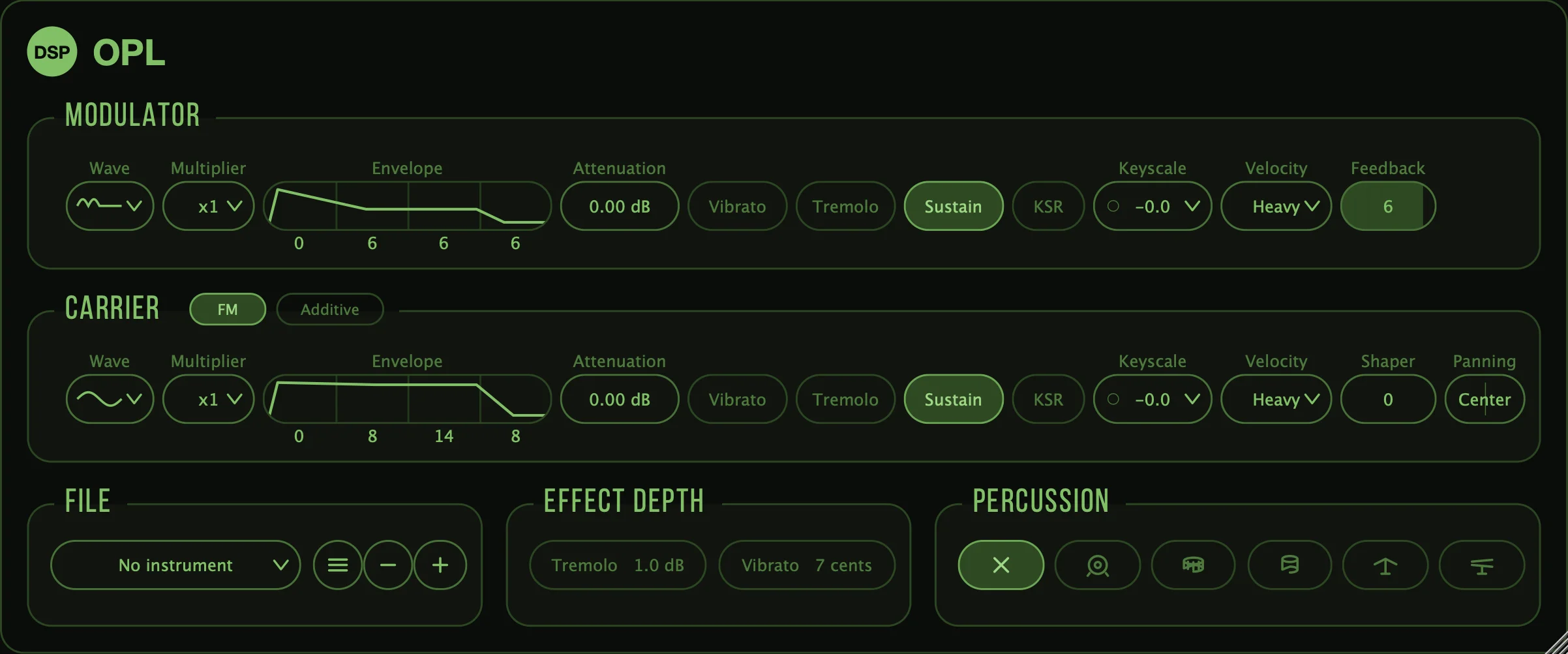
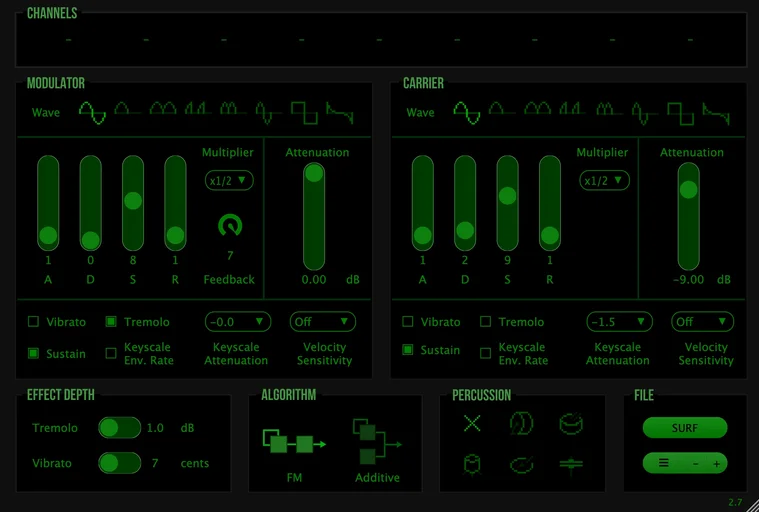
discoDSP OPL emulates the Yamaha OPL chips, the FM sound behind AdLib and Sound Blaster game soundtracks of the late 80s and 90s. Classic two-operator FM with all eight OPL3 waveforms and percussion mode, extended to multi-operator patches on a pool of eight YMF262 chips. 16x oversampling, over 11,000 instruments, SBI, WOPL and TX81Z import.
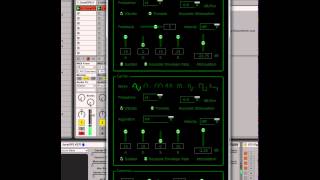
Overview
Built on the YMF262 (OPL3). Classic patches use the chip's two-operator channels the way AdLib and Sound Blaster games did, and multi-operator patches use its 4-op channel pairs. A pool of eight chips (144 channels) gives larger patches and unison room for chords.
Each operator has its own waveform, frequency multiplier, ADSR envelope, attenuation, key scaling and velocity response. Eight waveforms per operator: sine, half sine, absolute sine, quarter sine, alternating sine, camel sine, square, logarithmic sawtooth. The waveform set is what makes OPL sound like OPL, since sine alone won't get you there.
Multi-operator mode allows up to four modulators and four carriers per note. Choose one of eight algorithms (FM, Additive, 3-Stack, 4-Stack, Two Pairs, Stack + Sine, One to Three, Three Pairs) or build your own on a Yamaha-style algorithm chart: drag from a modulator to connect it, click a wire to remove it, click an operator to edit it. Each patch is compiled onto 2-op and 4-op chip channels. Multi-operator instruments are saved as .sbix, which other tools still read as a standard SBI.
Over 11,000 instruments are included: the SBI library sorted by category, 4-op and OPL3 banks made for PC games, General MIDI sets from classic game soundtracks and Yamaha TX81Z voices. WOPL and WOPLX banks (OPL3 Bank Editor, libADLMIDI), OPLI instruments and TX81Z, DX21, DX27 and DX100 sysex dumps load without conversion, with levels normalised so 4-op patches match 2-op ones. SBI presets (Creative Labs' instrument format for Sound Blaster cards) load by drag and drop.
Percussion mode adds bass drum, snare, tom, cymbal and hi-hat, each tied to specific operator slots and waveforms.
AN1x-style unison stacks five detuned layers per note with a 32-step detune depth and stereo spread, and key-tracked panning places notes across the stereo field by pitch. The output has a master volume from -48 to +12 dB and a Valve or Tape saturator that shapes only the peaks. MPE, the sustain pedal and sample-accurate MIDI timing are supported.
The emulation runs on a rewritten engine with quality work of our own. The chip itself is oversampled up to 16x, which cuts the aliasing that FM synthesis produces at high modulation settings, while pitch, envelope timing and key scaling are corrected so patches sound the same at every setting. Offline bounces switch to a linear-phase filter with reported latency, so a render matches what you monitored. Silent chips and channels are skipped, so CPU use follows what is sounding.
Supported Formats
Universal Binary 2: Native Intel and Apple Silicon.
Standalone Application: No additional software required.
ProTools AAX. Apple Audio Unit. Steinberg VST. Steinberg VST3.








System Requirements
 Windows 10+. IntelIntel processors with AVX2 support:
 10.14+. Apple Silicon or IntelMacBook Pro: Late 2013+
 Debian 10+. IntelIntel processors with AVX2 support:
 iOS 14 or later.
Credit and Licensing
FM synthesis is powered by ymfm, the Yamaha sound chip emulation library by Aaron Giles, used under the BSD 3-Clause License. Yamaha, YM3812, YMF262, AN1x, TX81Z, DX21, DX27 and DX100 are trademarks of Yamaha Corporation, used here only to describe the hardware this product emulates.