Synthesizers
Sampler & Effects
Emulators & Voice
Controllers & Editors
Presets by Product
Highlights
Sound Designers
Vertigo is an additive synthesizer with 512 Euler-generated oscillators per voice (-120 dB noise floor). Resynthesizes audio and image files through FFT analysis. Dual morphable A/B states with 256-breakpoint envelopes per partial (phase, amplitude, frequency). Two filters routable in series or parallel with six filter types, 128-band formant filter, eight effects, 16-voice polyphony, scalable HiDPI GUI.
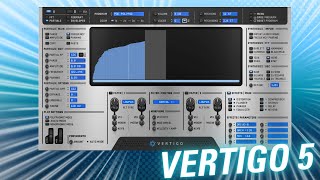

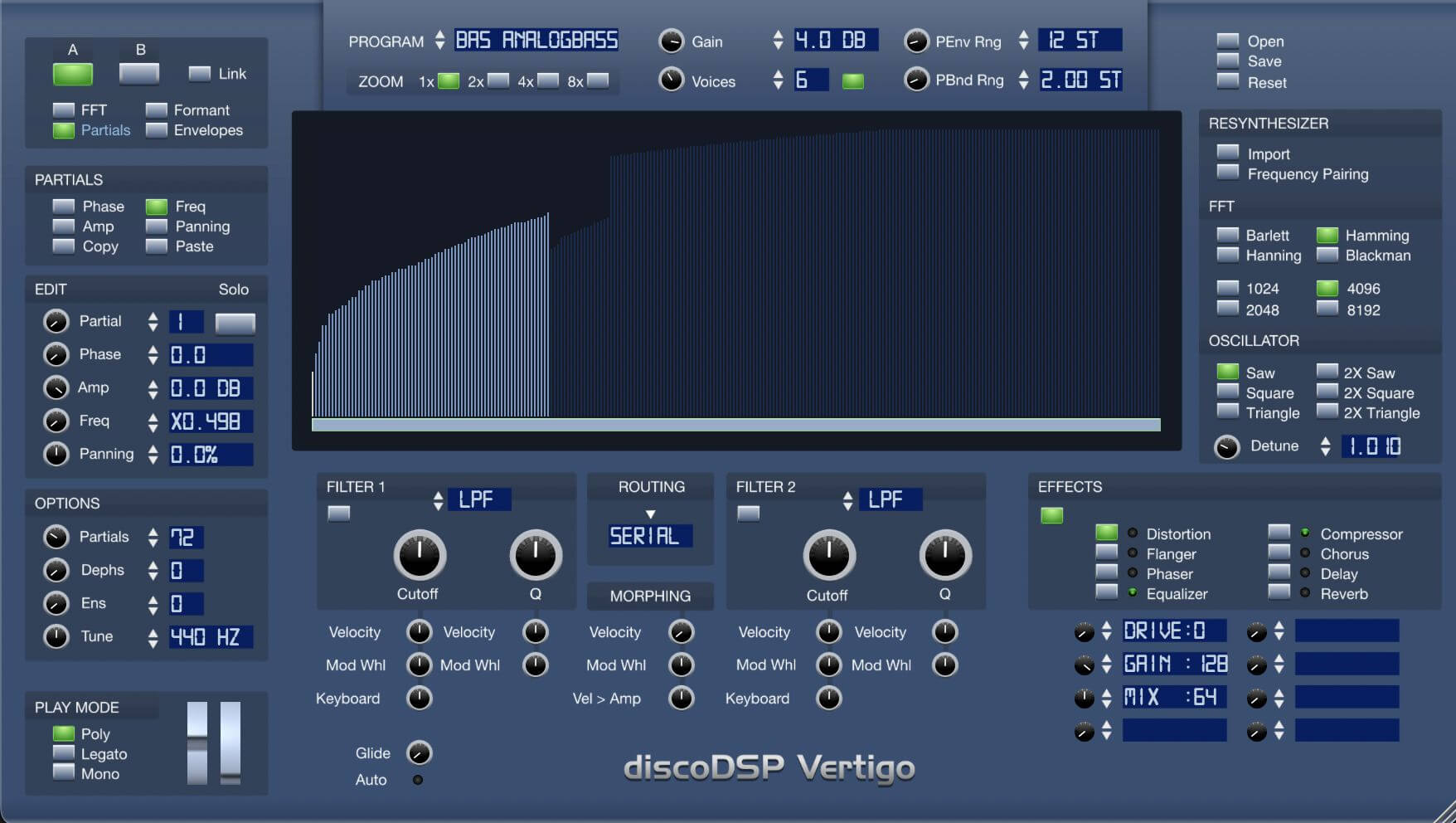
Additive synthesis based on Fourier analysis: build a sound from individual partials, or analyze an existing audio file and reconstruct it from those partials. Material ranges from drawbar-organ tones to abstract textures that aren't reachable from a subtractive synth.
Additive engine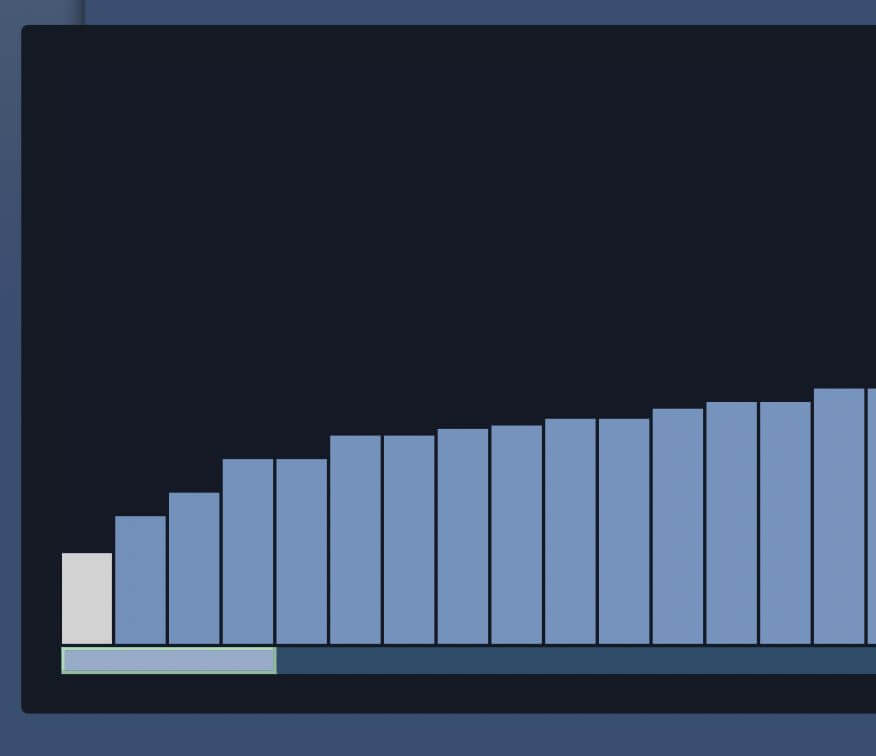
Up to 512 Euler-generated oscillators per voice, no wavetables. Noise floor sits at -120 dB.
Two parameter states (A/B) per voice, with morphing between them driven by mod wheel, velocity, or automation. Each partial has independent phase, amplitude, frequency ratio, and pan.
Per-partial envelopes go up to 512 breakpoints with parabolic interpolation.
Resynthesis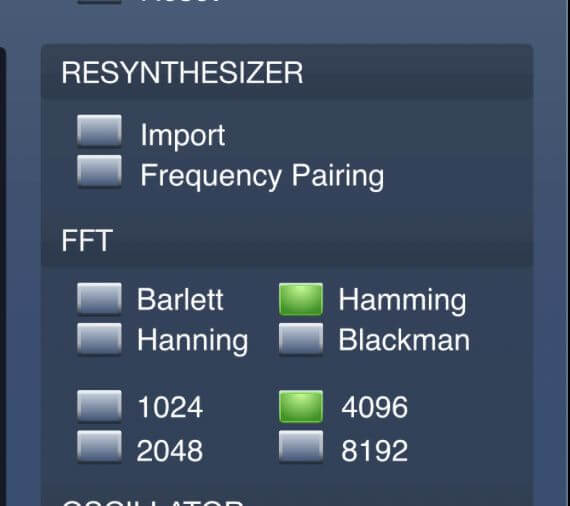
FFT-based: drop a WAV in and Vertigo decomposes it into partials with their amplitude and frequency envelopes. The result plays back as additive synthesis you can edit.
FFT frame sizes 1024 / 2048 / 4096 / 8192. Windowing options Bartlett, Hamming, Hanning, Blackman. Larger frames help with bass-heavy material; smaller frames keep transients.
Frequency Pairing reorders partials between the A and B states so morphing crossfades the closest frequency partners. This avoids the artifact pile-up you get when partial 1 in A morphs to partial 1 in B regardless of pitch.
Spectral editor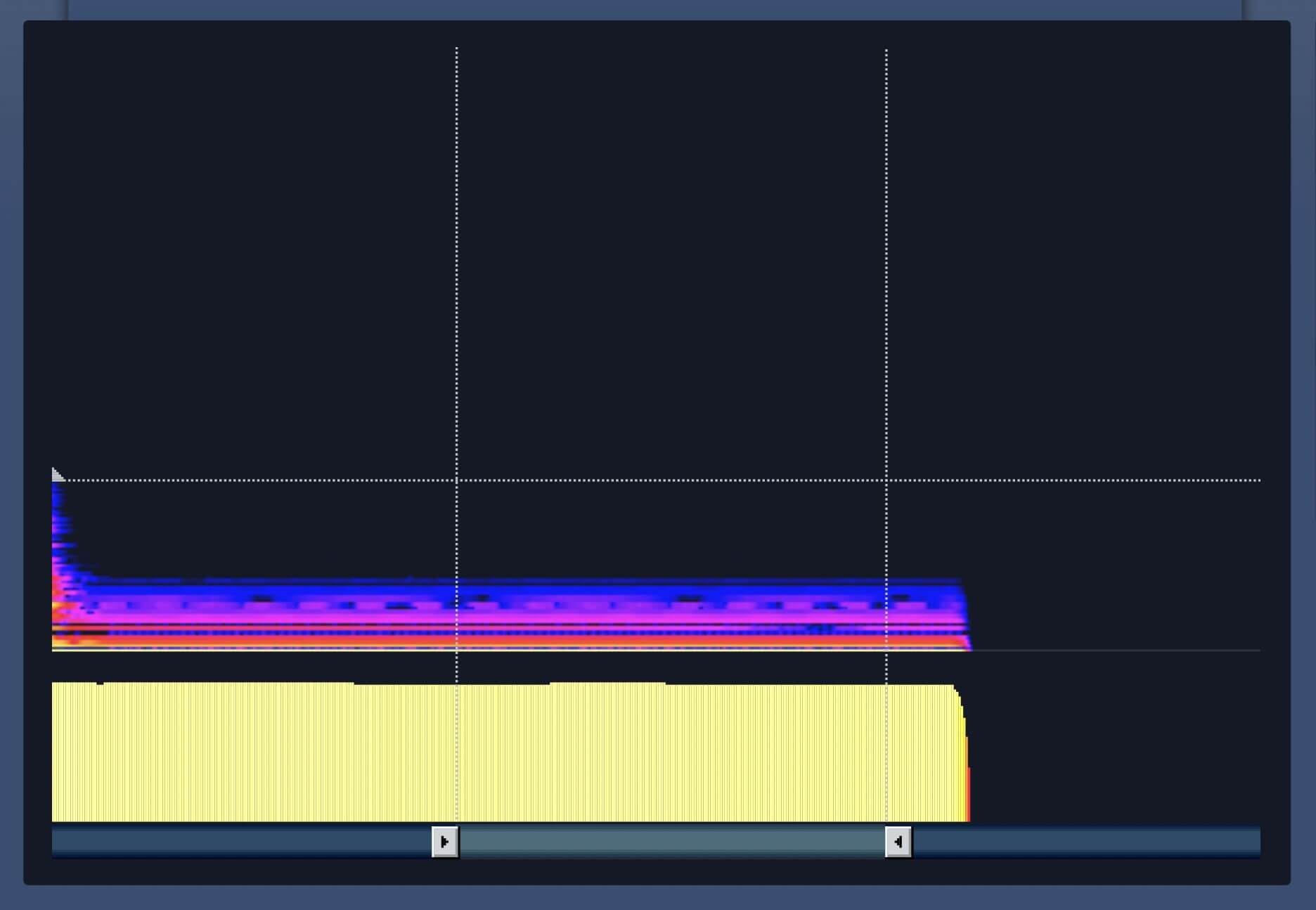
Spectrogram-style editor: amplitude and frequency live on the canvas, edits happen directly there.
Horizontal and vertical fades, boost and cut, and partial-range selection. Behaves like a graphic EQ on the partials, with the underlying additive structure intact.
PNG / JPG import as harmonic templates: pixel rows map to partials, columns to time. Image input as a sound source rather than a metaphor.
Harmonization modes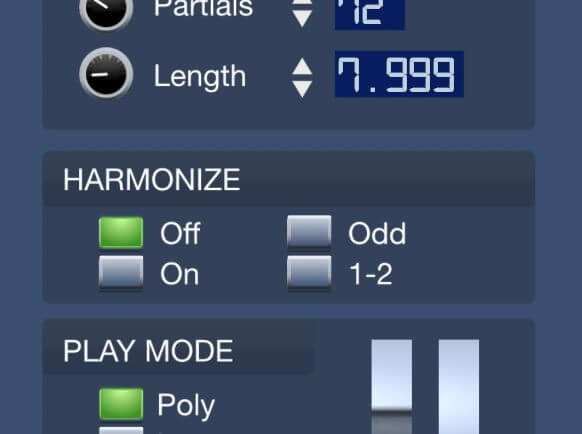
Harmonic: integer multiples of the fundamental, for drawbar organs and brass.
Odd Harmonic: odd partials only, for clarinet-style hollow tones. 1-2 Serial: proportional ratios from the gap between the first two operators, for bells and metallic textures.
Combine with the phase and frequency smearing controls to deviate from rigid harmonic relationships.
Dual filters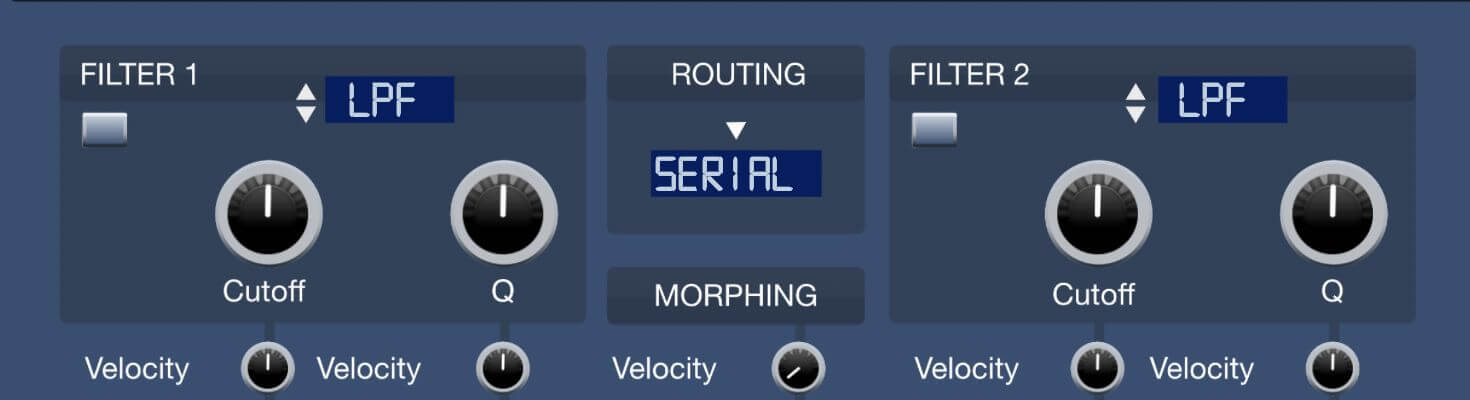
Two resonant filters, routable in series or parallel, with six selectable types: 4-pole LP, 4-pole HP, 2-pole BP, 4-pole BP, 4-pole notch, 4-pole peak.
Series for subtractive shaping, parallel for splitting bands or building phasing effects. Velocity, keytrack, and mod wheel route to cutoff and resonance.
Dedicated bipolar filter envelopes. The 128-band formant filter handles vowel-like and vocal-character processing.
LFO modulation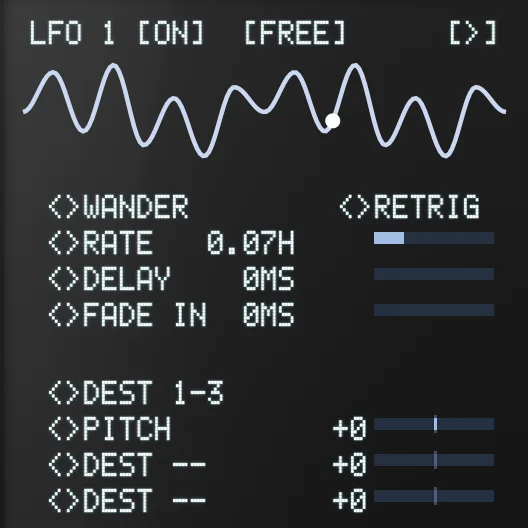
Three per-voice LFOs, each with its own waveform, rate, delay, fade in and key retrigger. Sine, wander, triangle, saw, reverse saw, square and random, plus a custom shape you draw yourself. Free running in Hz or locked to a host tempo division.
Nine routing slots per LFO, each with a destination and a bipolar amount: pitch, fine tune, both filter cutoffs and resonances, morph, stretch, amplitude, pan, the formant filter, or the rate and depth of another LFO for cross modulation.
A playhead rides each waveform preview, so speed, delay and fade are visible before a note is played. Twenty-six factory presets cover vibrato, tremolo, filter motion, panning, morph, sample and hold, formants and stretch. LFO settings can be held across program changes while browsing sounds.
MPE
MIDI Polyphonic Expression applied per note. Bend (X), slide (CC74, Y) and pressure (Z) are tracked per member channel, so you can bend, brighten and swell one finger while the rest of the chord holds still. Each axis carries its own destination and bipolar amount, a response curve, a range and a smoothing time.
Plug in a LinnStrument, ROLI Seaboard, Sensel Morph, Haken Continuum or Expressive E Osmose and the MPE Configuration Message sets the zone and per-note bend range on its own. Lower or upper zone, bend range up to 48 semitones, and a poly aftertouch mode that drives the Z axis from a normal keyboard. Six factory presets, and the setup can be held across program changes.
Effects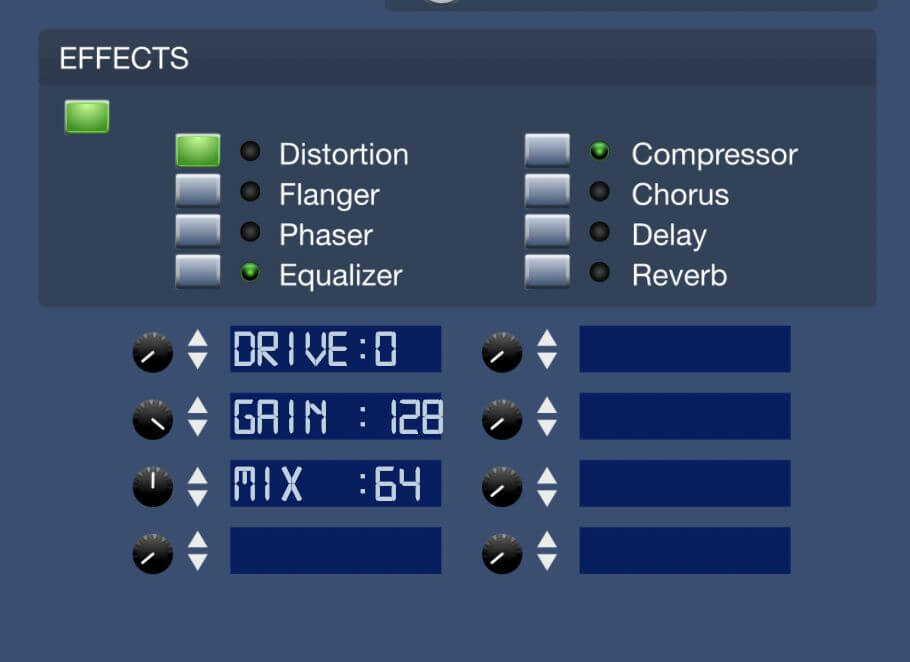
Eight effects tuned for additive material.
Distortion at 8x oversampling (no aliasing on partials), phaser up to 128 taps, flanger, compressor, 8-band EQ.
Stereo chorus, tempo-synced delay, reverb.
Scalable Retina interface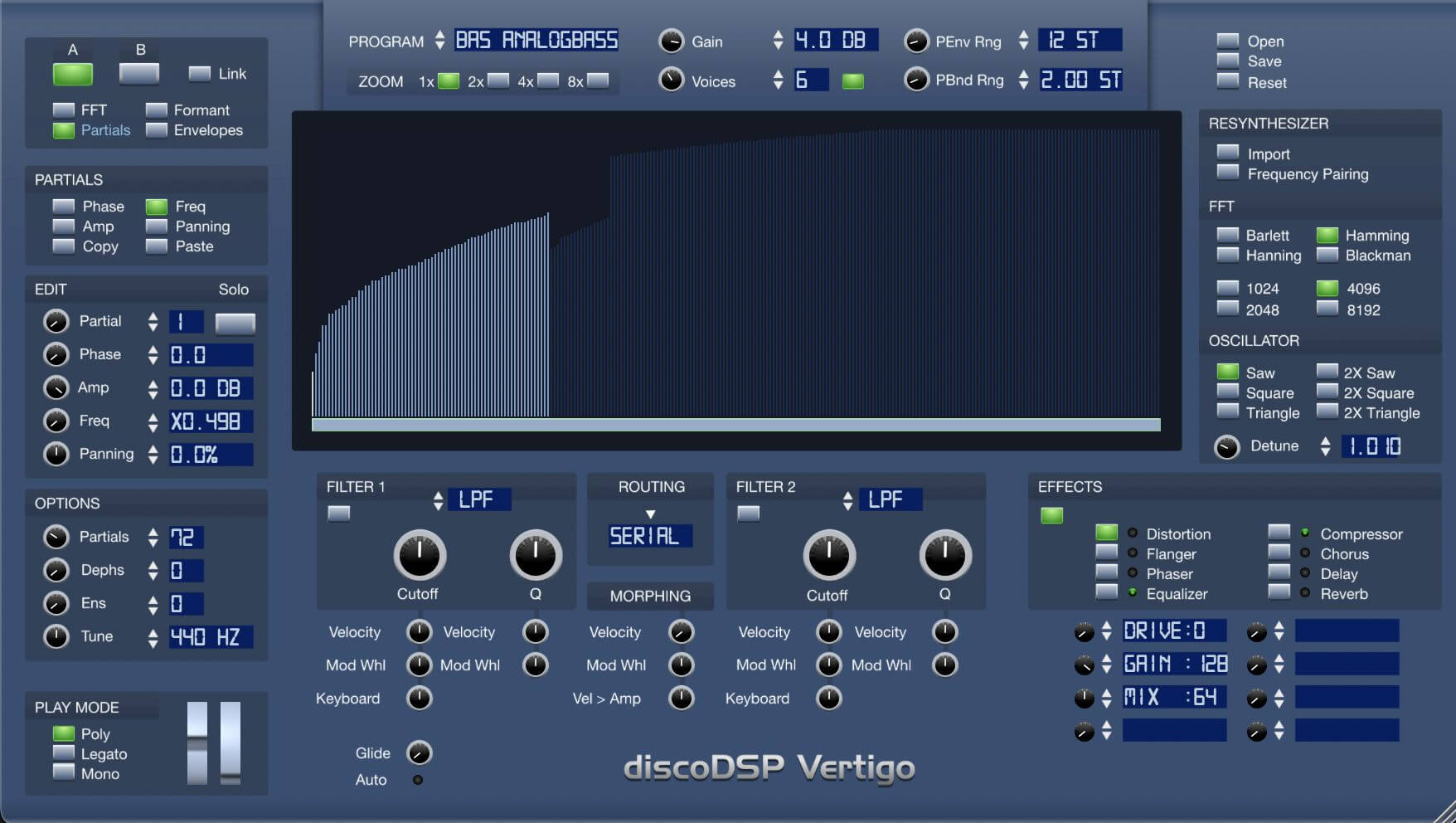
HiDPI throughout, multi-threaded rendering so the GUI stays responsive while 512 partials run.
Spectral display, envelope editor, and per-partial activity meters all visible at once. Zoom for detail work.
Drag-and-drop for audio files and images. Built-in bank browser.
Polyphony and performance
Up to 16 voices, with poly / mono / legato modes. AVX2 on x86 and NEON on Apple Silicon keep it usable with all 512 partials active.
Pitch bend, mod wheel, velocity, and full automation on every parameter.
Zero-delay feedback in the signal path. Standalone app included.
Supported Platforms
Universal Binary 2: Native Intel and Apple Silicon.
Standalone Application: No additional software required.
ProTools AAX. Apple Audio Unit. Steinberg VST. Steinberg VST3.






System Requirements
 Windows 10+. IntelIntel processors with AVX2 support:
 10.14+. Apple Silicon or IntelMacBook Pro: Late 2013+
 Debian 10+. IntelIntel processors with AVX2 support: