
Synthesizers
Sampler & Effects
Emulators & Voice
Controllers & Editors
Presets by Product
Highlights
Sound Designers
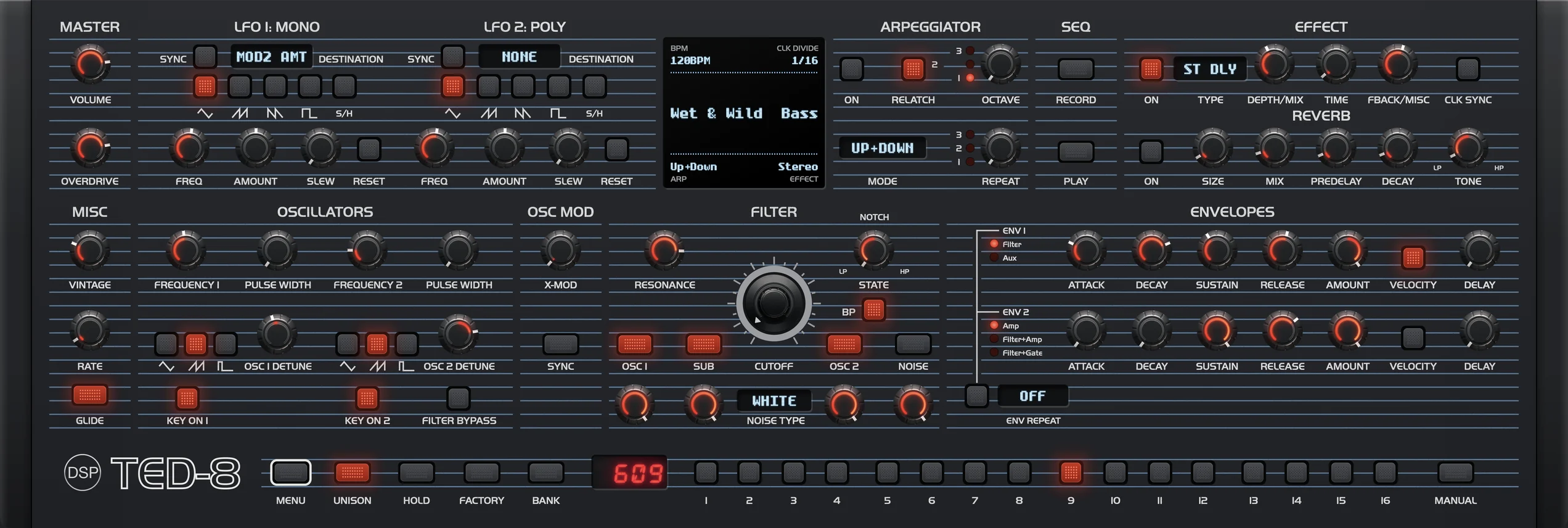
TED-8 is the Oberheim TEO-5 as a plugin, built from hundreds of measurements of a real unit. Every knob, every curve and every effect was recorded, compared and tuned until the plugin and the hardware sounded the same side by side. Then we gave it three more voices, a Poly Unison mode that stacks up to 6 voices on each of 8 notes (48 voices at once), a full modulation matrix and a cable to the real thing, so TED-8 works on its own in your DAW or as the editor and librarian for the TEO-5 on your desk.
Launch price for a limited time. TED-8 will be $199 after the intro period.
Own Discovery, Discovery Pro, Corona, OB-Xd 2 or OB-Xd 3? Thank you for being with us all these years. TED-8 is yours for $49, for a limited time.
Sign in to claim ›How we modeled it
We started with a TEO-5 on the bench and a lot of patience. One note at a time, one knob step at a time, we recorded what the unit actually does: how far the filter moves per step, how the envelopes curve, how fast each LFO setting runs, how each effect colors the sound. TED-8 follows those recordings rather than a datasheet, so a patch you dial in feels and responds the way it does on the hardware.
The little imperfections came along too. Each voice sits a few cents apart and a touch louder or softer than its neighbour, the way the voices of the unit do, so chords breathe instead of sounding cloned.
Full replication

Everything on the TEO-5 front panel is here and works the way you expect: two oscillators with sub and noise, the SEM-style filter, two envelopes, two LFOs, glide, unison, the arpeggiator, the step sequencer, overdrive, the effect section and the reverb. TED-8 uses the TEO-5's own MIDI CC numbers and reads and writes its programs, so a sound you make in the plugin is a sound the hardware can play, and the other way around.
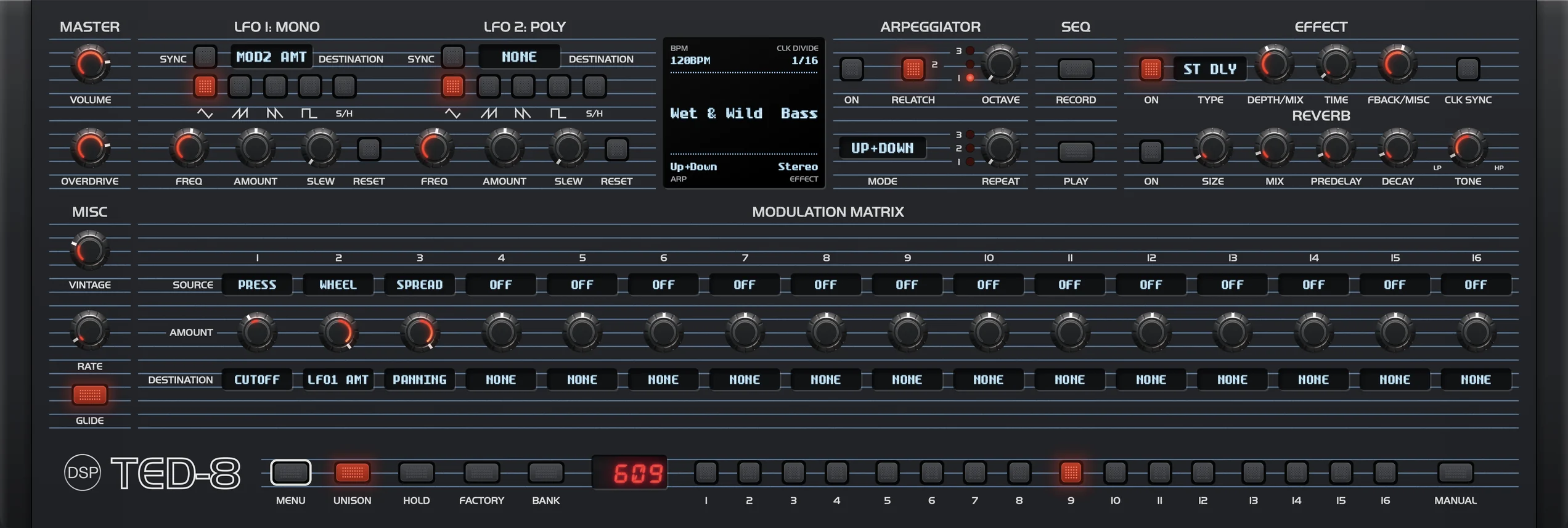
Where the plugin can go further, it does: 8 voices instead of 5, Poly Unison with up to 48 voices, and a 16-slot modulation matrix on screen.
Link to your TEO-5
Own a TEO-5? Plug it in over USB and TED-8 finds it. Turn a knob on the unit and the plugin follows, move a control in the plugin and the unit answers. Program changes stay in step both ways, sequences you record on either side land in the same program, and you can back up all 256 user programs to a single file and restore them later.
It turns an evening of menu diving into a few clicks, and your hardware patches finally live inside your projects.
Master and LFOs
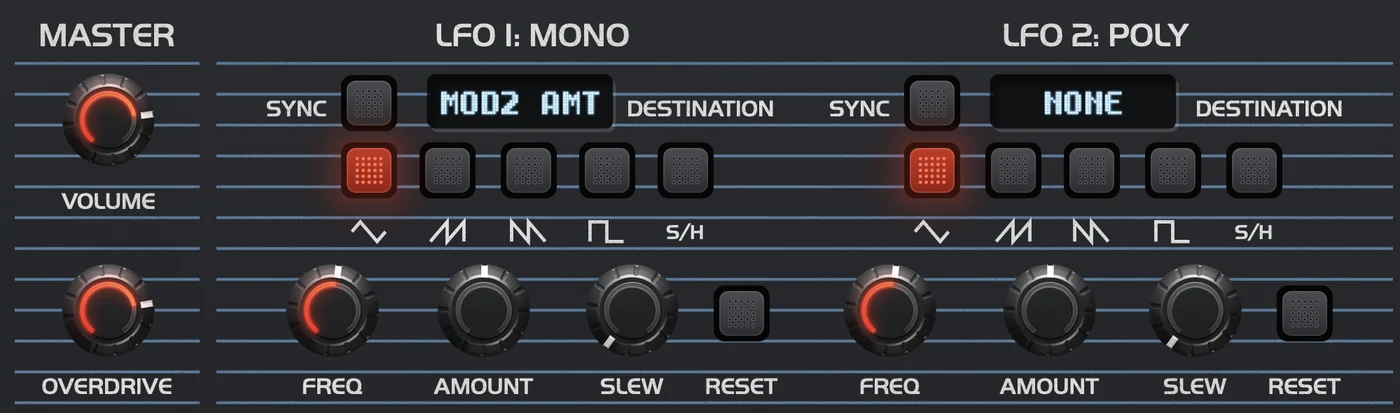
Volume and Overdrive sit up front for quick level and grit. LFO 1 runs once for the whole synth, LFO 2 runs separately for every voice, and each has five shapes, tempo sync, slew to soften the steps and a reset that restarts the cycle on every note. Pick a destination on the small display and the LFO goes there.
Screen, Arpeggiator and Sequencer
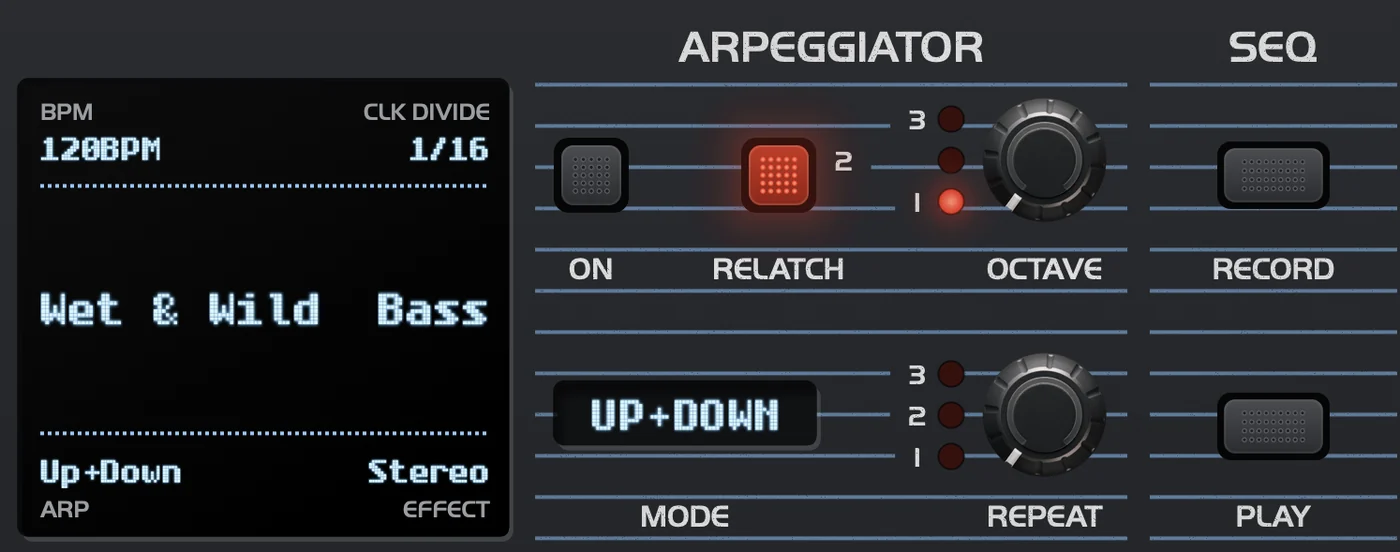
The screen shows tempo, clock divide, the program name, the arp mode and the current effect, and each corner opens a menu when you click it. While you turn a knob it draws what you are changing, from the filter shape to the pulse width.
The arpeggiator plays Up, Down, Up+Down, Random or in the order you press the keys, over up to three octaves with note repeats and relatch. The sequencer records up to 64 steps with chords of up to five notes, rests and ties, and plays it back from a single key so you can transpose it as you go.
Effects and Reverb
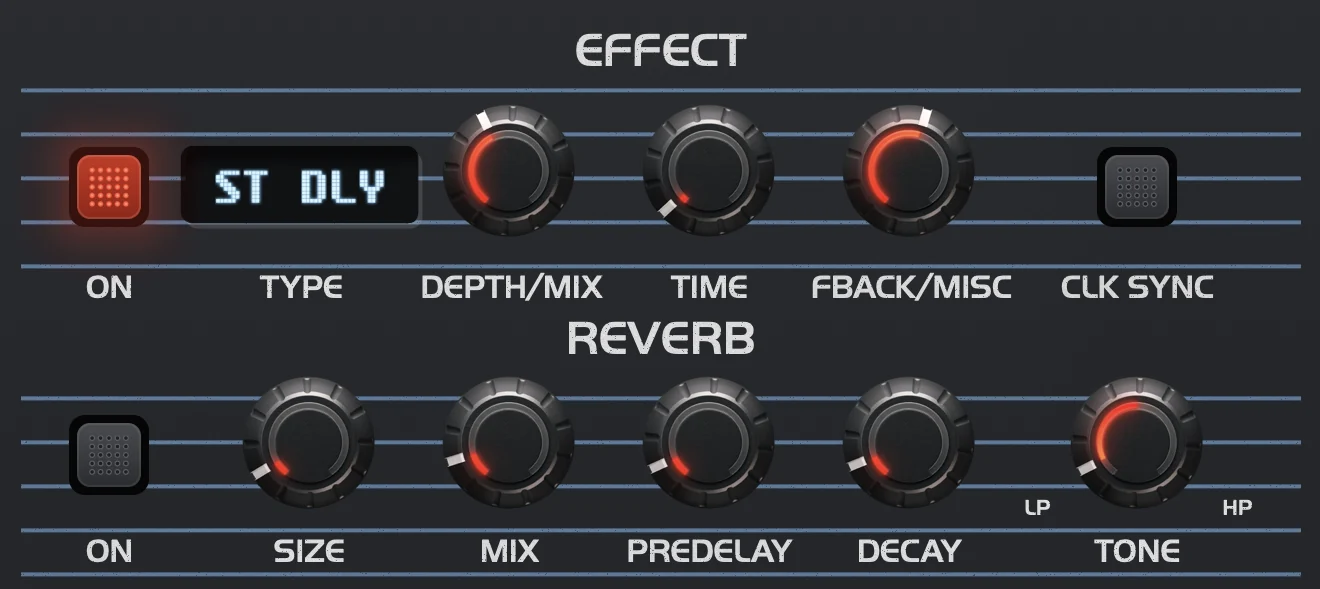
Twelve effect types: stereo, BBD and tape delays, chorus, flanger, phaser, a high pass filter, distortion, ring mod, rotating speaker and lo-fi, each with depth, time and feedback controls and clock sync. Behind it a reverb with size, predelay, decay and a tone control that tilts the tail darker or brighter. All of it was matched against the hardware's own effects.
Oscillators
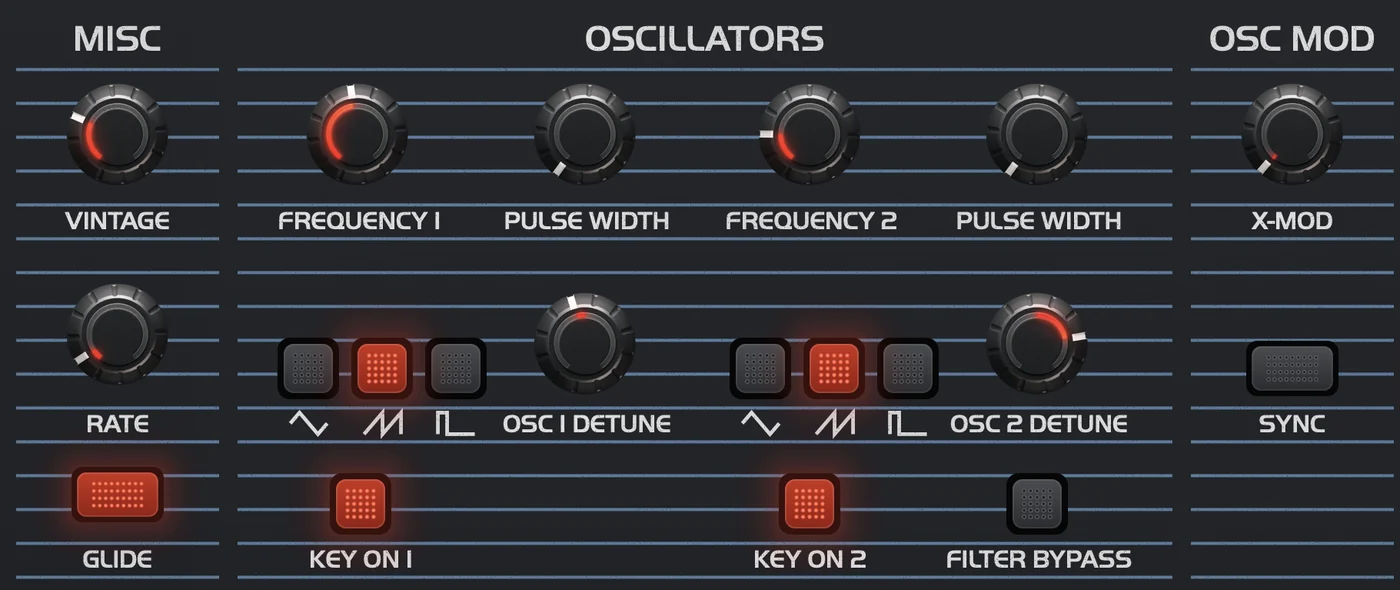
Two oscillators with triangle, saw and pulse that you can switch on together, a sub oscillator one octave down and noise. X-Mod lets oscillator 2 bend the pitch of oscillator 1 for metallic and bell-like tones, Sync locks them for the classic tearing lead, and the screen draws the result while you turn the knob. Key On lets either oscillator ignore the keyboard for drones, and Filter Bypass sends oscillator 2 around the filter so it stays bright while the rest is dark.
Right-drag or Shift-drag a frequency knob to move in octaves.
Filter
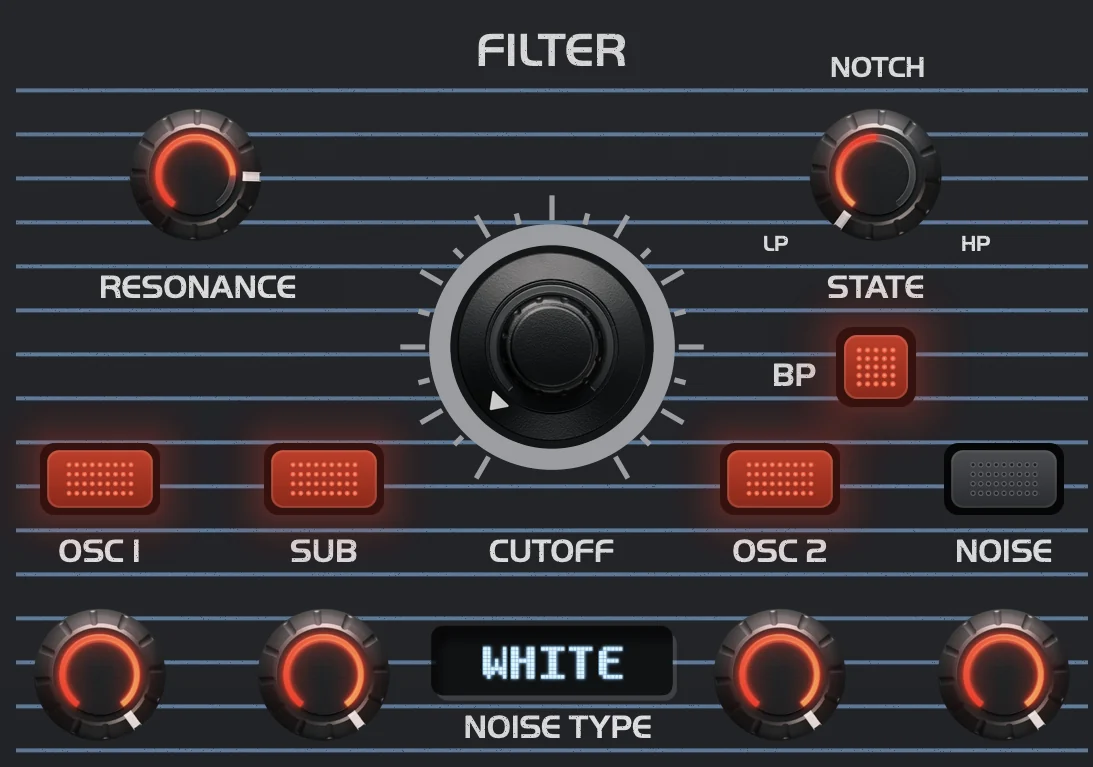
The heart of the sound. A 2-pole state-variable filter in the style of the Oberheim SEM that glides from low pass through notch to high pass with one knob, plus a band pass switch. It stays round and musical as you push resonance, and the big cutoff knob shows where the filter is right now, envelopes and LFOs included. The mixer for oscillators, sub and noise sits right below it.
Envelopes
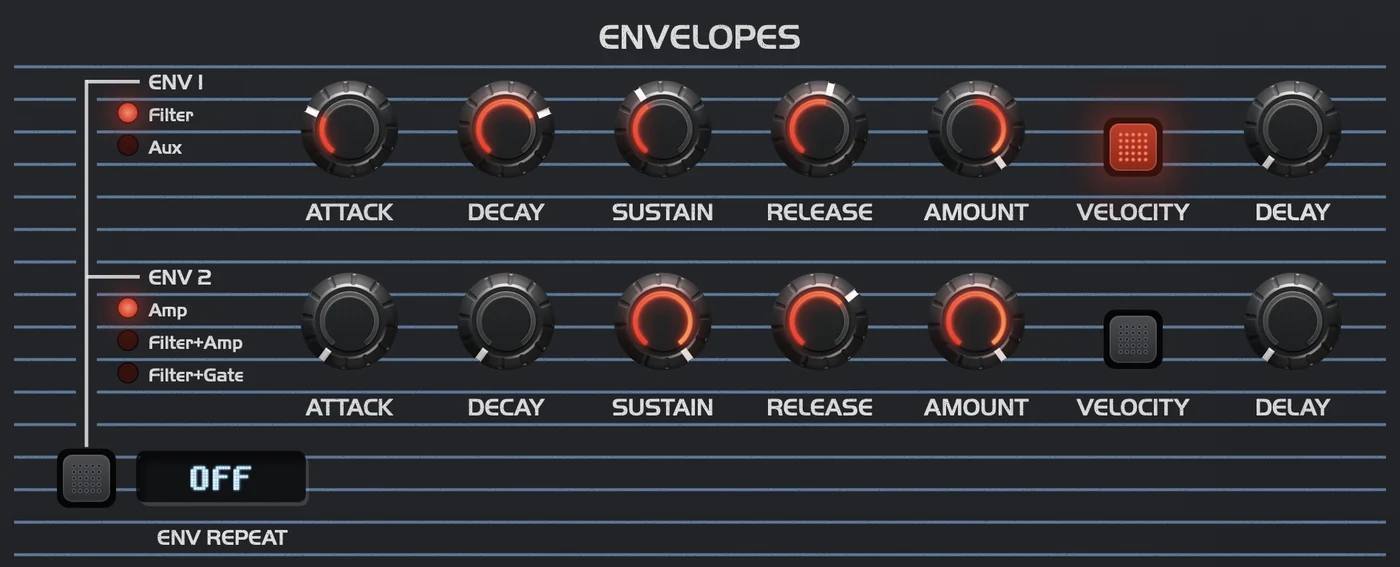
Two envelopes with delay, attack, decay, sustain and release, an amount knob and velocity. Envelope 1 drives the filter and an extra destination of your choice, envelope 2 drives the amp, or one envelope can drive both. Env Repeat loops the attack and decay for rhythmic pulses that never stop. The stages light up as they play so you can see what you hear.
Modulation Matrix
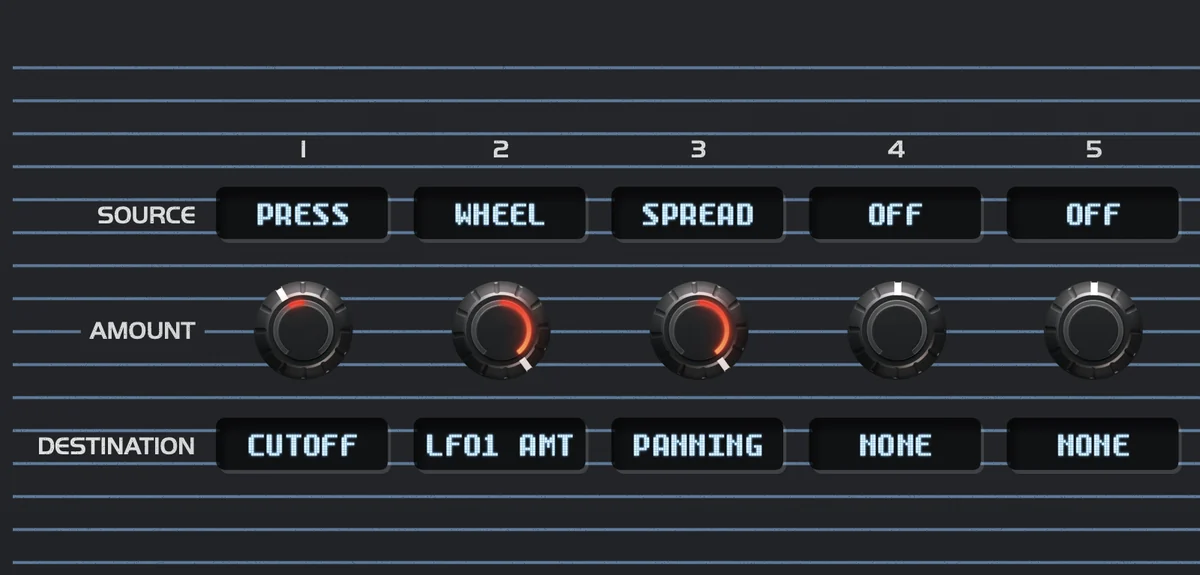
Press M and the lower panel turns into a 16-slot modulation matrix. Pick a source, from velocity, pressure, mod wheel and pedals to the LFOs, envelopes, voice spread and even oscillator 2, set an amount and choose a destination, grouped by panel section so it is easy to find. Every slot moves in the same steps as the hardware.
Programs

The bottom row works like the unit: 16 program buttons, a bank button and a number display. Click the program name on the screen to browse sounds by bank or by category, and press the current program again to undo your edits. TED-8 also opens OB-Xd presets, and every control can learn a MIDI CC from a right-click.
Supported Formats
Universal Binary 2: Native Intel and Apple Silicon.
Standalone Application: No additional software required.
ProTools AAX. Apple Audio Unit. Steinberg VST. Steinberg VST3.






System Requirements
 Windows 10+. IntelIntel processors with AVX2 support:
 Monterey 12.0+. Apple Silicon or IntelMacBook Pro: Late 2013+
Credits
TED-8 by George Reales. Oberheim and TEO-5 are trademarks of their respective owners and are used only to describe the instrument TED-8 is modeled on. TED-8 is not affiliated with or endorsed by Oberheim.


