Cross-Plugin Data Transport via Shared Memory
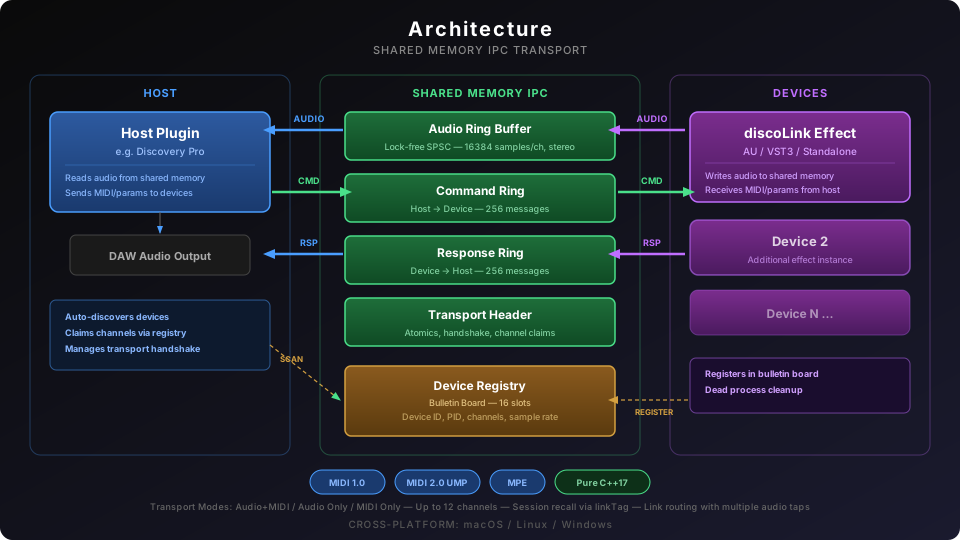
Cross-plugin data transport via shared memory. discoLink enables real-time audio streaming and bidirectional MIDI/parameter control between independent processes — designed as an intra-plugin bridge for modular operation. Route full synth paths, individual oscillators, envelopes, filters, or external effects into a host plugin with near-zero latency. Open source under the MIT License.
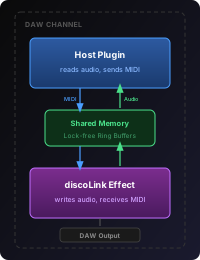
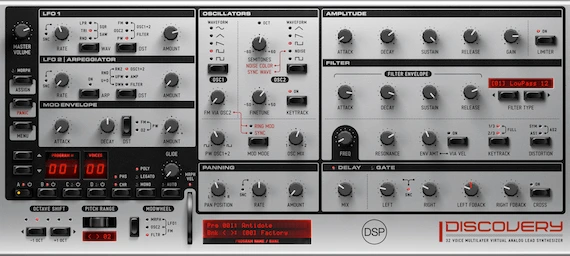
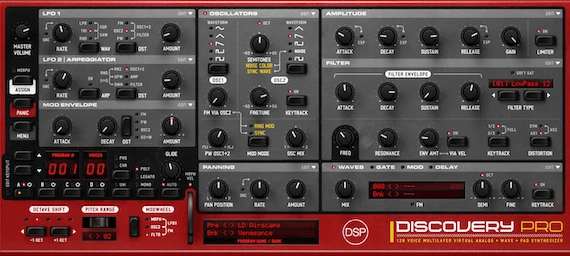
discoLink uses two plugin instances on the same DAW channel: a Host Plugin (e.g. Discovery Pro) that reads audio from shared memory and sends MIDI commands, and a discoLink Effect that writes audio to shared memory and receives commands. Audio flows through lock-free ring buffers with near-zero latency — no function calls cross the process boundary.
The same architecture works across separate OS processes. A standalone synth can register as a device, and a DAW plugin can discover and connect to it automatically. Shared memory ring buffers and opaque 256-byte IPC messages handle all communication.
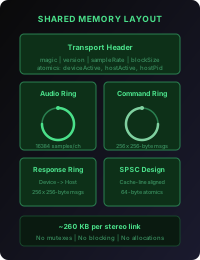
At the core of discoLink is a lock-free Single-Producer Single-Consumer (SPSC) ring buffer architecture. Audio buffers hold 16,384 samples per channel with cache-line aligned atomics to prevent false sharing. No mutexes, no blocking, no allocations in the audio path — safe for real-time threads.
Command and response rings carry 256-byte fixed-size messages for MIDI, parameter changes, preset loading, file exchange, and routing control. Protocol-versioned handshakes negotiate capabilities, buffer sizes, and sample rates bidirectionally.
Three transport modes are available: Audio+MIDI (default), Audio-only, and MIDI-only — allowing you to choose exactly the overhead your integration needs.
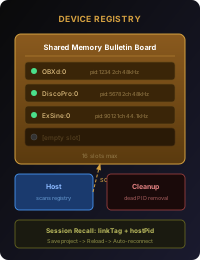
Devices register in a shared memory bulletin board with 16 slots. Hosts scan the registry to auto-discover running devices, check claim status, and connect without any manual configuration.
Dead processes are automatically cleaned via PID validation. Host claim tracking with linkTag support enables seamless DAW session recall — save your project, reload, and discoLink reconnects to the same devices automatically.
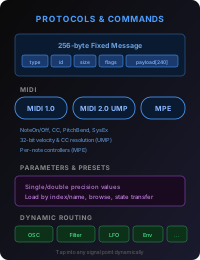
discoLink supports classic MIDI 1.0 (NoteOn/Off, CC, Program Change, Pitch Bend, SysEx), full MIDI 2.0 Universal MIDI Packet with 32-bit velocity and CC resolution, and MPE (MIDI Polyphonic Expression) with per-note controllers.
Beyond MIDI, the protocol handles parameter setting (single/double precision, normalized), preset management (load by index/name, browsing, state transfer), file exchange (WAV, SFZ, presets), and dynamic routing — tap into any oscillator, filter, LFO, envelope, gate, or output bus.
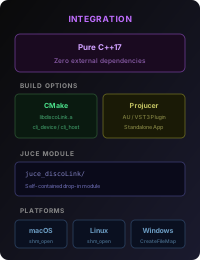
discoLink is pure C++17 with zero external dependencies. The core library builds as a static library with no framework lock-in. A self-contained JUCE module (juce_discoLink) is available for drop-in integration with Projucer or CMake projects.
Reference CLI tools (device, host, master) are included for testing the full IPC chain without a DAW. The AU/VST3 plugin acts as a polyphonic sine device for end-to-end validation.
Cross-platform support covers macOS (POSIX shm_open), Linux (POSIX shm_open), and Windows (Win32 CreateFileMapping). Builds via CMake or Projucer.
discoLink is released under the MIT License. The full source code, documentation, API reference, and protocol specification are available on GitHub.